222 Palisades Creek Drive
Richardson, TX 75080
Phone: 972-952-9393
Fax: 972-952-9435
Email: [email protected]
Project: Re-Imagining Hillyard

Project: Re-Imagining Hillyard
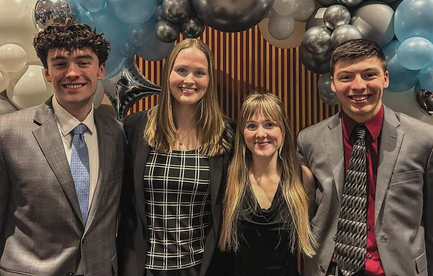
Students: Baila Burnam, Karlynn Kenny, Eider Schantz, and Alex Willis
Faculty: Dr. Rhonda Young, P.E., and Dr. Mutasem Alzoubaidi, P.E.
What value does a real-world project bring to students?
Real-world projects offer the context and open-endedness that can’t be simulated in a classroom setting. We design transportation projects for people but it’s hard to meaningfully do this unless students can experience interacting with real people who will be using these facilities. It brings the complexity and importance of the work.
Students gained hands-on experience using industry-standard simulation software, rigorous data collection protocols, and translating complex technical outputs into clear recommendations for stakeholders.
How do you decide which projects to work on?
At Gonzaga we are fortunate to have a very active Center for Community Engagement that has developed long term relationships with communities. We base our relationships on reciprocity by recognizing the value these communities give us in providing these real-world experiences for our students.
How did this project prepare students for professional practice?
The project required a full array of professional skills beyond technical ones including communication with technical and non-technical audiences, project management, and engagement with community.
What advice do you have for other programs wanting to add similar collaborative projects to their curriculum?
Explore the relationships that your campus community has already nurtured so that this effort is part of a broader engagement so that its not just something that happens for the academic year and then ends.
Integrate industry-standard analysis tools early in the project timeline and actively involve practicing engineers to mentor students through technical simulation and workflow challenges.
What did you like best about participating in this project?
I liked that this project had direct impact on the Spokane Hillyard community and that we as a team were able to go into the community and hear the concerns and hopes of the residents regarding this project.
I think the privilege to be given huge amounts of responsibility, on a demanding project, that also has the potential to address changes that a community is passionately asking for was incredibly rewarding, and kindled a flame within myself for the profession as a whole.
I really enjoyed the opportunity to be able to participate in real community meetings as it showed me how this project had real community impact.
What did you learn?
I learned that you can’t please everyone and that in transportation projects everyone has an opinion, good or bad. I also learned that traffic analysis forecasting never shows a “bad” result just provided us with helpful information about the facility we are analyzing.
In terms of magnitude, my knowledge of how to use programs like Vissim were some of the biggest areas of improvement I experienced. But I think the most valuable areas were the more broad soft skills, things like how to conduct a stakeholder meeting, how to professionally speak about transit/traffic subjects, and general traffic/transit problem solving.
I learned that there is a lot of work that goes into the traffic analysis aspect of a project and I definitely gained a newfound appreciation for this.
How did the participation of professional engineers improve the experience?
The participation of professional engineers improved this experience by providing their different skillsets and tools to improve the results of our project. Utilizing PTV VISUM and VISSIM on this project increased the validity and accuracy of our results.
I think professional engineers really help to create structure. As a student it’s easy enough to try and tackle a specific task, but trying to understand how one task relates to others or where to go next is a more difficult question.
It was really awesome to work with professional engineers from the city and other companies. It showed how knowledgeable these professionals are in their fields.
What do you think the engineers learned from working with students on this project?
From working with students on this project, I think the engineers learned how to teach young engineers how to use the traffic simulation software and what the different outputs meant in real world scenarios.
I think a lot of them were impressed with the work we did, so I would say they learned that even student engineers can produce professional work when we work together.
Why did you get involved with the project?
I got involved with the project because I wanted to mentor transportation professionals on a real-life project.
How did you assist the students in the project?
I met with the students weekly to review their activities and help them plan for their next week. I also provided technical support of traffic modeling.
What did you learn from working with the students?
I learned that future engineers have fresh perspectives on how to approach problems, with creative solutions to existing constraints. I also learned that graduating students are already learning how to be communicate with one another and work with a team.
What did you want students to learn from working with you?
I wanted the students to learn that the project they were working on has a real potential to be implemented and shape the future of the community.